



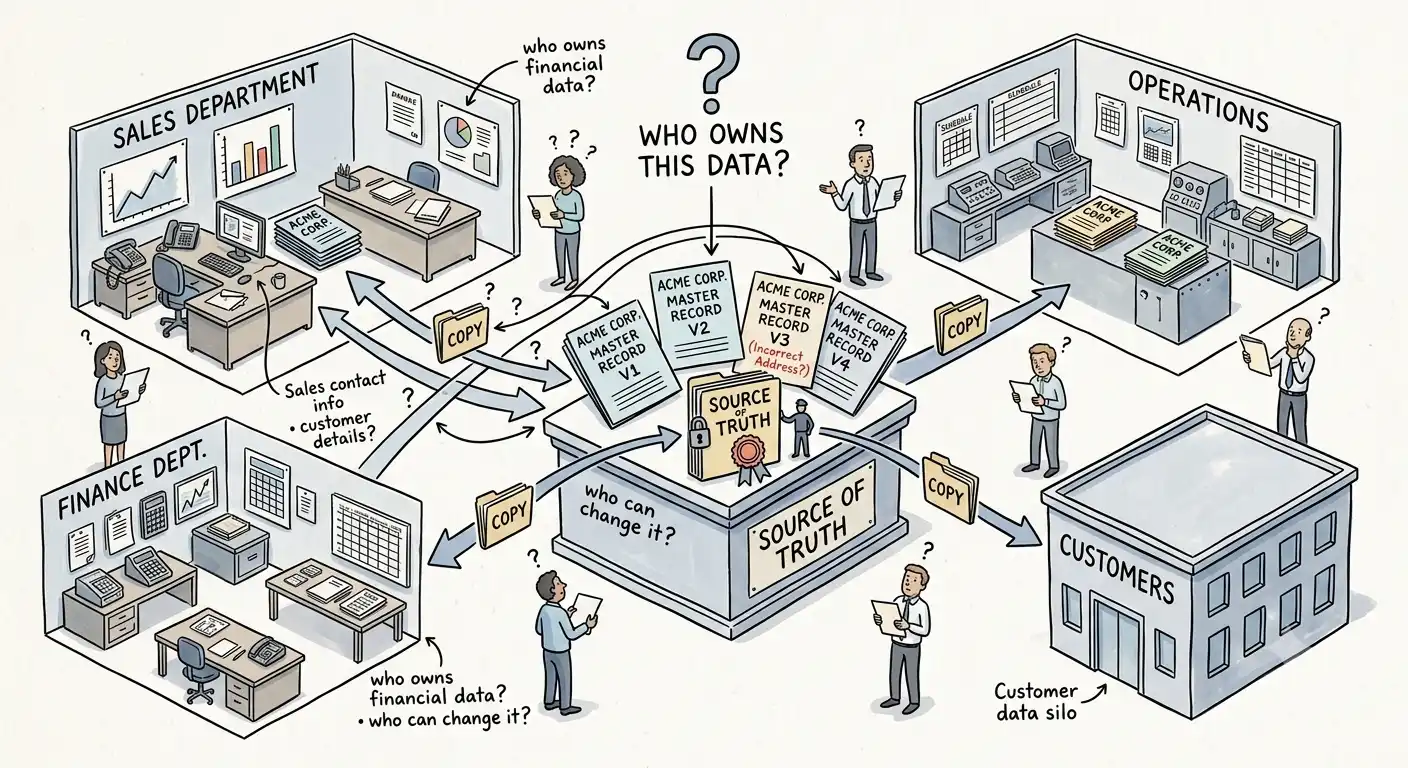

Data ownership sounds like an administrative issue.
It isn't.
It can determine whether a software system remains reliable as it grows.
If nobody knows who owns the data, sooner or later different systems will start making different assumptions about what is correct.
What does “ownership” mean?
Suppose a company has customer information in three systems.
The CRM has an address.
The accounting system has an address.
The internal application has an address.
Which one is correct?
If an employee changes the address in one system, should the others change automatically?
What happens if they don't?
Without a clear answer, integration becomes guesswork.
Ownership doesn't necessarily mean control
The system that owns the data isn't necessarily the only system allowed to use it.
It means there is a clear source of truth and a clear responsibility for maintaining that information.
For example:
The CRM may own customer contact information.
The accounting system may own invoices.
The HR system may own employee records.
Other systems can use that information.
But they shouldn't quietly become competing sources of truth.
Duplicate data creates problems
Copying data isn't automatically wrong.
Sometimes it is necessary.
The problem is when nobody knows which copy is authoritative.
Then you get situations like:
“The CRM says the customer is active, but the portal says inactive.”
Now someone has to investigate.
Was one system not updated?
Was the integration delayed?
Was somebody allowed to edit the wrong record?
The technical problem is often a symptom of an ownership problem.
Define the rules before building integrations
Before connecting systems, decide:
Which system owns each important piece of data?
Which systems can read it?
Which systems can modify it?
How are changes communicated?
What happens when an update fails?
How are conflicts handled?
Who is responsible for correcting bad data?
These decisions can save a lot of technical complexity later.
Data ownership is also a business decision
Technology teams can't always answer these questions alone.
For example, should a customer's legal name be controlled by sales, finance or operations?
That's a business decision.
Engineering can build the mechanism.
The business needs to decide what the rules are.
Build the rules before the integration
It's tempting to start with APIs and database structures.
Sometimes the better starting point is much simpler:
“Who is responsible for this information?”
Once that is clear, the technical design becomes easier.
Good systems don't just move data around.
They know where important data comes from, who is responsible for it and what should happen when something goes wrong.