



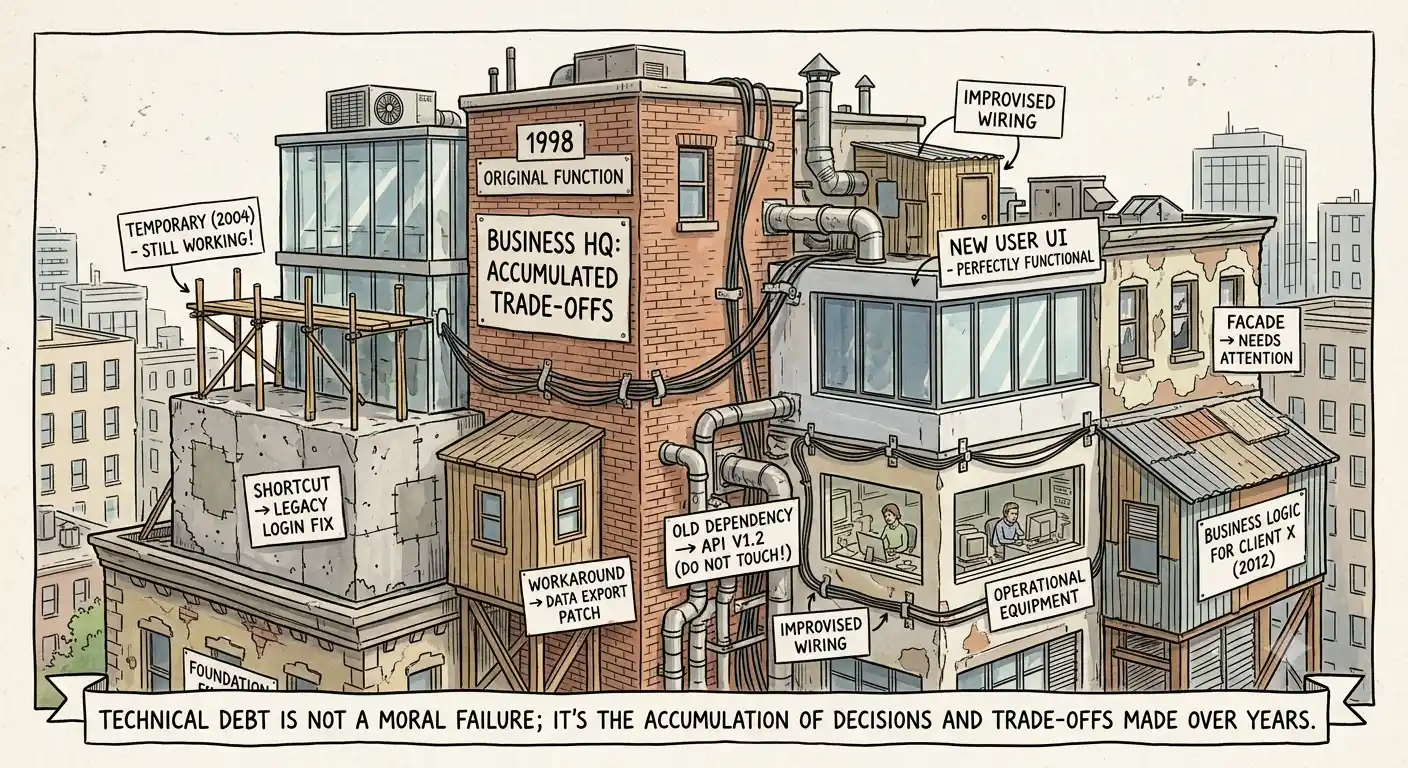

“Technical debt” has become a phrase that gets used almost like an accusation.
The code is old.
The architecture isn't perfect.
There are workarounds.
The tests aren't where they should be.
Someone says:
“We have a lot of technical debt.”
And suddenly it sounds like somebody made terrible decisions.
That's not necessarily true.
Software Debt Happens
Every software system makes trade-offs.
A business may need something delivered quickly.
A feature may be more important than refactoring.
A temporary workaround may be perfectly reasonable when the business is under pressure.
Sometimes you simply don't have enough information yet to make the perfect technical decision.
That's normal.
The problem isn't having technical debt.
The problem is not knowing what debt you have or what it is costing you.
Not All Debt Is Bad
Think about why a particular shortcut was taken.
Maybe the company needed to launch before a deadline.
Maybe a small customer requirement had to be handled quickly.
Maybe the team didn't yet understand how the system would evolve.
A decision that was reasonable three years ago may no longer be reasonable today.
That doesn't make the original decision stupid.
It means circumstances changed.
The Real Problem Is Expensive Debt
Some technical debt barely matters.
A slightly untidy piece of code may never cause a problem.
Other debt creates serious consequences.
For example:
A small change requires touching many unrelated parts of the system.
Developers need days to understand simple functionality.
Releases are becoming increasingly risky.
Security updates are difficult.
Nobody knows what certain components do.
The business avoids useful changes because the technical risk is too high.
That's debt worth paying attention to.
Don't Try to Pay Everything Back
One common reaction is to create a huge “technical debt cleanup” project.
That can be just as problematic.
Not every old piece of code needs to be rewritten.
Not every architectural imperfection matters.
The better question is:
Which technical problems are currently holding the business back?
Start there.
If a particular area makes every future change difficult, improve that area.
If a component is stable and rarely touched, it may not deserve immediate attention.
Debt Needs Priorities
A useful way to think about technical debt is through four questions:
How risky is it?
Could it cause an outage, security issue or serious data problem?
How often do we touch it?
A painful component that changes every week deserves more attention than one that nobody touches.
How much does it slow us down?
Does it add hours, days or weeks to ordinary work?
What happens if we leave it alone?
Sometimes the answer is “nothing significant.”
That's useful information too.
Good Engineering Is About Trade-offs
There will always be compromises in software.
You can't optimise everything at once.
The goal isn't to create a system with zero technical debt.
The goal is to understand the trade-offs and manage them deliberately.
Technical debt isn't a sign that your team failed.
Sometimes it's simply the accumulated history of business decisions.
The important thing is knowing when that history has started making the business slower, riskier or more expensive.
That's when it's time to do something about it.