



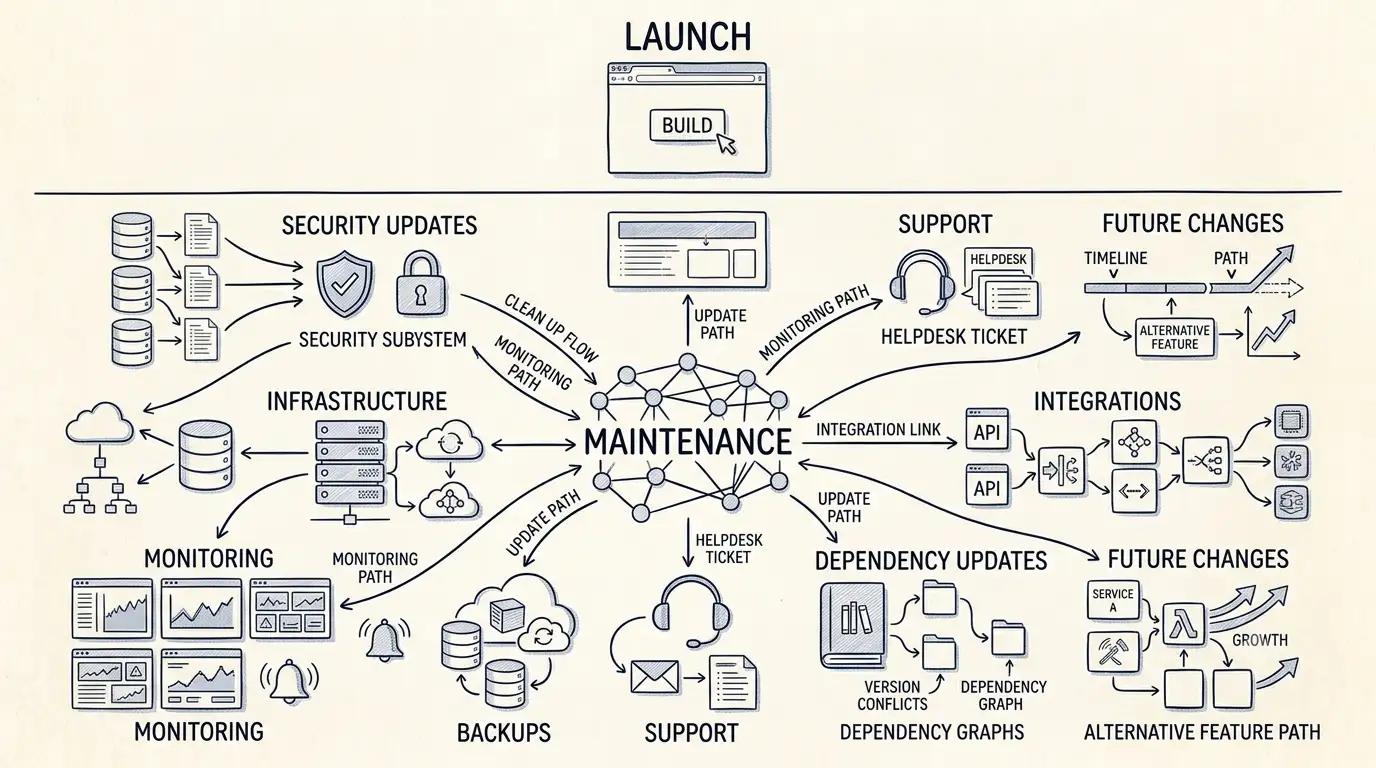

Most software budgets focus heavily on one number:
How much will it cost to build?
That's understandable.
But building the software is only part of the cost.
The real cost often appears afterwards.
Software Needs Attention After Launch
Once people start using an application, reality takes over.
Users find problems.
Business processes change.
Browsers and operating systems change.
Third-party services change their APIs.
Security vulnerabilities are discovered.
New reporting requirements appear.
Customers ask for new functionality.
The software becomes more important.
All of that creates ongoing work.
Maintenance Isn't Just Fixing Bugs
When people hear “maintenance,” they often think of fixing broken things.
That's only one part.
There is also:
Security updates
Infrastructure management
Monitoring
Backups
Performance work
Compatibility changes
Dependency updates
Integrations
Small improvements
User support
Technical documentation
Some of this work is visible.
A lot isn't.
But someone still has to do it.
The Cheapest Build Can Become the Expensive System
Suppose two vendors propose similar applications.
One costs significantly less.
That sounds attractive.
But what happens after launch?
Can your team understand the code?
Are deployments straightforward?
Are there tests?
Is the system documented?
Are dependencies maintained?
Can another developer take over?
If every small change requires the original developer, the initial saving may disappear quickly.
This is why software cost should be considered over its useful life, not just during development.
The Business Cost Matters Too
Technical maintenance isn't the only hidden cost.
Poor software creates operational costs.
Employees may spend an extra 20 minutes every day working around a process.
A manager may spend hours reconciling reports.
Someone may manually move information between systems.
A small error may require several people to investigate.
These costs rarely appear on the software invoice.
But they are real.
Predictability Matters
The goal isn't necessarily to spend as little as possible.
The goal is to understand what you're spending and why.
A healthy system should give you some confidence about:
What needs regular maintenance
What changes are likely to cost
What parts carry the most risk
Who can work on the system
What happens when something fails
Predictability is valuable.
A business can manage a known annual maintenance cost.
It's much harder to manage a system where every change feels like opening a box of surprises.
Think Beyond Launch
When evaluating a software project, ask two separate questions:
What will it cost to build?
and
What will it cost to own?
The second question is often ignored.
It shouldn't be.
Software isn't a building that is finished when construction ends.
It is something the business will continue to depend on.