



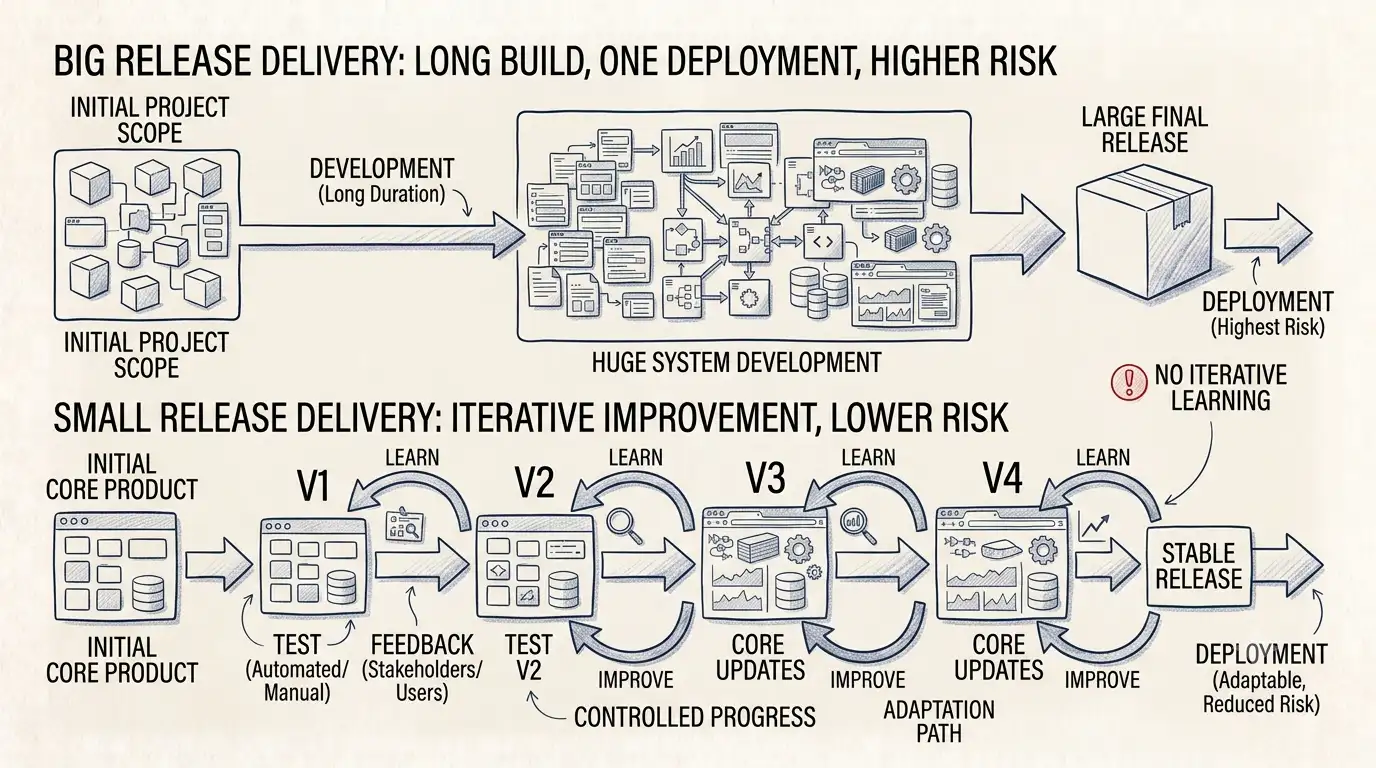

There is something satisfying about a big software launch.
Months of work.
A polished presentation.
A brand-new system.
Everyone finally sees it.
The problem is that software doesn't always behave the way we expect when real people start using it.
That's why we generally prefer smaller releases.
Small releases expose mistakes early
Suppose you're building a new customer workflow.
You can spend six months building the entire thing.
Or you can release the most important part first.
The second approach gives you something valuable:
feedback.
Maybe users don't understand one step.
Maybe a business rule was misunderstood.
Maybe the workflow is technically correct but awkward in practice.
Finding that out after two weeks is much better than finding it out after six months.
Smaller doesn't mean careless
A small release still needs to be properly tested.
It should be stable enough for its intended users.
The point isn't to release unfinished software.
The point is to reduce the amount of uncertainty in each release.
You build a useful piece.
You learn.
Then you build the next piece.
Big releases hide assumptions
Large projects often contain hundreds of assumptions.
What users want.
How data behaves.
How systems interact.
How a business process actually works.
What edge cases exist.
The longer you build without testing those assumptions, the more expensive they become.
Small releases force assumptions into the open.
Progress becomes easier to see
Small releases also create a clearer conversation with the business.
Instead of:
“We're 60% done.”
You can say:
“This workflow is live. These users are using it. Here's what we learned. Here's what we're changing next.”
That's much more useful.
The conversation becomes about actual software rather than percentages.
Small releases reduce risk
If something goes wrong, the affected area is smaller.
If priorities change, less work has been committed.
If the business learns something new, the team can adjust.
If a feature turns out to be unnecessary, you haven't spent six months building everything around it.
This doesn't mean every project should be broken into tiny pieces.
Some systems require substantial groundwork.
But whenever possible, we prefer to create opportunities to learn early.
The goal is not speed at any cost
Small releases aren't about rushing.
They're about learning sooner.
Good software development isn't simply:
Plan → Build → Launch
It's closer to:
Understand → Build → Test → Learn → Improve
Then repeat.
The more often you can do that safely, the less likely you are to spend months heading confidently in the wrong direction.