



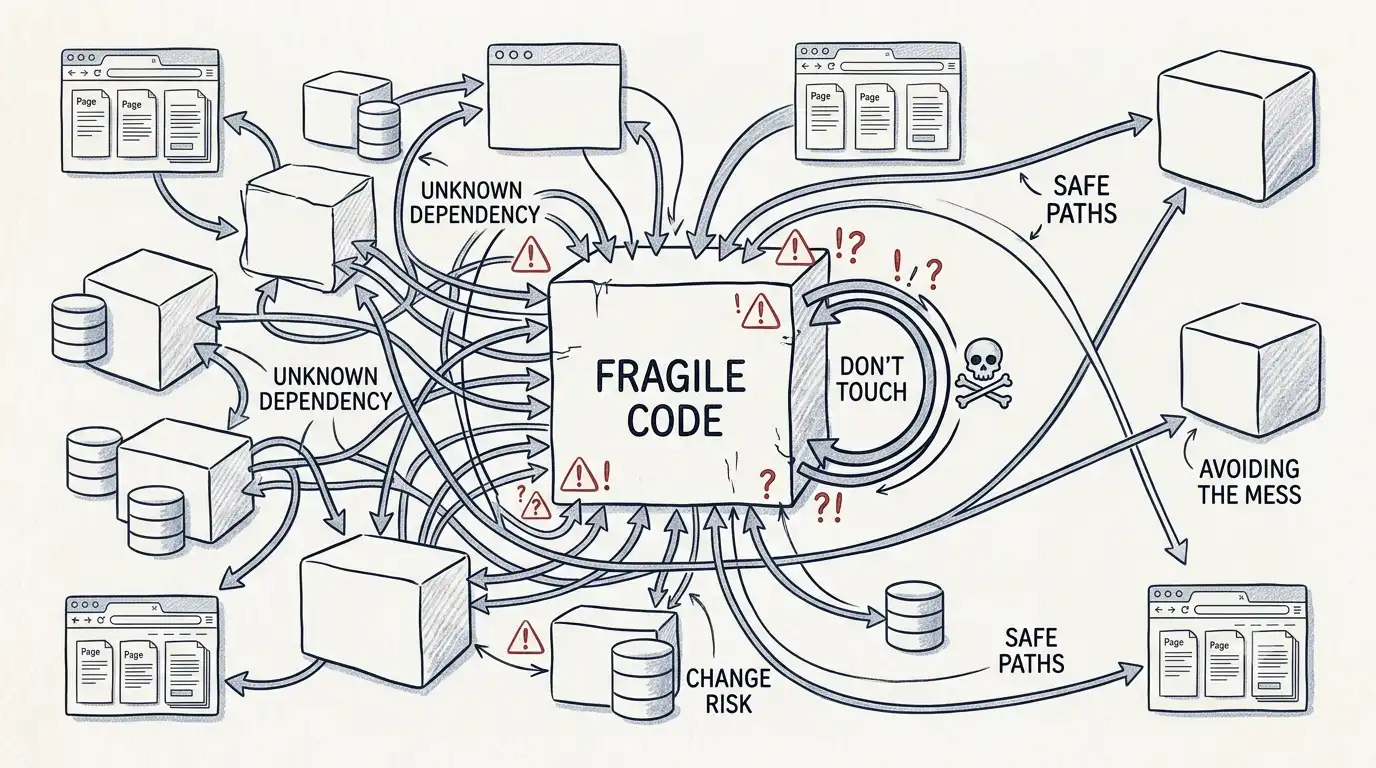

There is a particular moment in the life of a software system when everyone becomes careful.
Someone asks:
“Can we change this?”
The response is:
“Technically, yes.”
Then comes the uncomfortable silence.
Nobody wants to touch it.
Not because the developers are lazy.
Because nobody knows what will happen if they do.
Fear Is a Technical Signal
When developers are afraid to change code, something is usually wrong.
Perhaps the code is poorly structured.
Perhaps there are no automated tests.
Perhaps documentation is missing.
Perhaps one small component is connected to everything else.
Perhaps previous changes caused unexpected failures.
Perhaps the original developers understood the system in ways nobody else does.
Whatever the reason, the fear itself is useful information.
It tells you the system has become difficult to reason about.
The Real Cost Is Slower Change
This problem doesn't always show up as a large invoice.
It appears as hesitation.
A developer spends two days investigating before making a change that should have taken two hours.
Another developer avoids improving an area because it looks risky.
A simple request gets pushed into a future release.
Testing becomes manual.
People ask for approvals because nobody is confident about the consequences.
The business becomes slower.
That's technical debt becoming operational debt.
“Don't Touch It” Isn't a Maintenance Strategy
Sometimes leaving something alone really is the correct short-term decision.
If a critical system is stable and a particular area is extremely risky, you may decide not to change it immediately.
That's different from pretending there is no problem.
You should know:
Why the area is risky
What depends on it
What would happen if it failed
How difficult it would be to change
What could be done to reduce the risk later
That turns fear into a known technical constraint.
Start With Understanding
You don't necessarily need to rewrite the code.
A good first step might be mapping the system.
Find the important workflows.
Identify dependencies.
Understand the data.
Look at deployment.
Find the areas with the highest risk.
Then make small, controlled improvements.
For example, adding tests around an important piece of business logic can make future changes safer.
Separating one tightly coupled component can make another area easier to modify.
Improving logging can make failures easier to investigate.
Small changes can create confidence.
Good Code Isn't Code Nobody Can Break
A useful system isn't one where developers promise:
“We'll never break it.”
That's unrealistic.
Good engineering makes the consequences of change understandable.
Developers should be able to answer:
What does this change affect?
What could fail?
How will we know?
How can we roll it back?
That's what makes a system maintainable.
The Goal Is Confidence
Eventually, you want the conversation to change.
From:
“Should we touch this?”
to:
“Yes. Here's what we're changing, here's what it affects, and here's how we'll verify it.”
That is a much healthier software system.
The objective isn't to make old code beautiful.
It is to make the system understandable enough that competent engineers can safely work on it.
And when nobody wants to touch the code, that's usually the problem worth fixing first.