



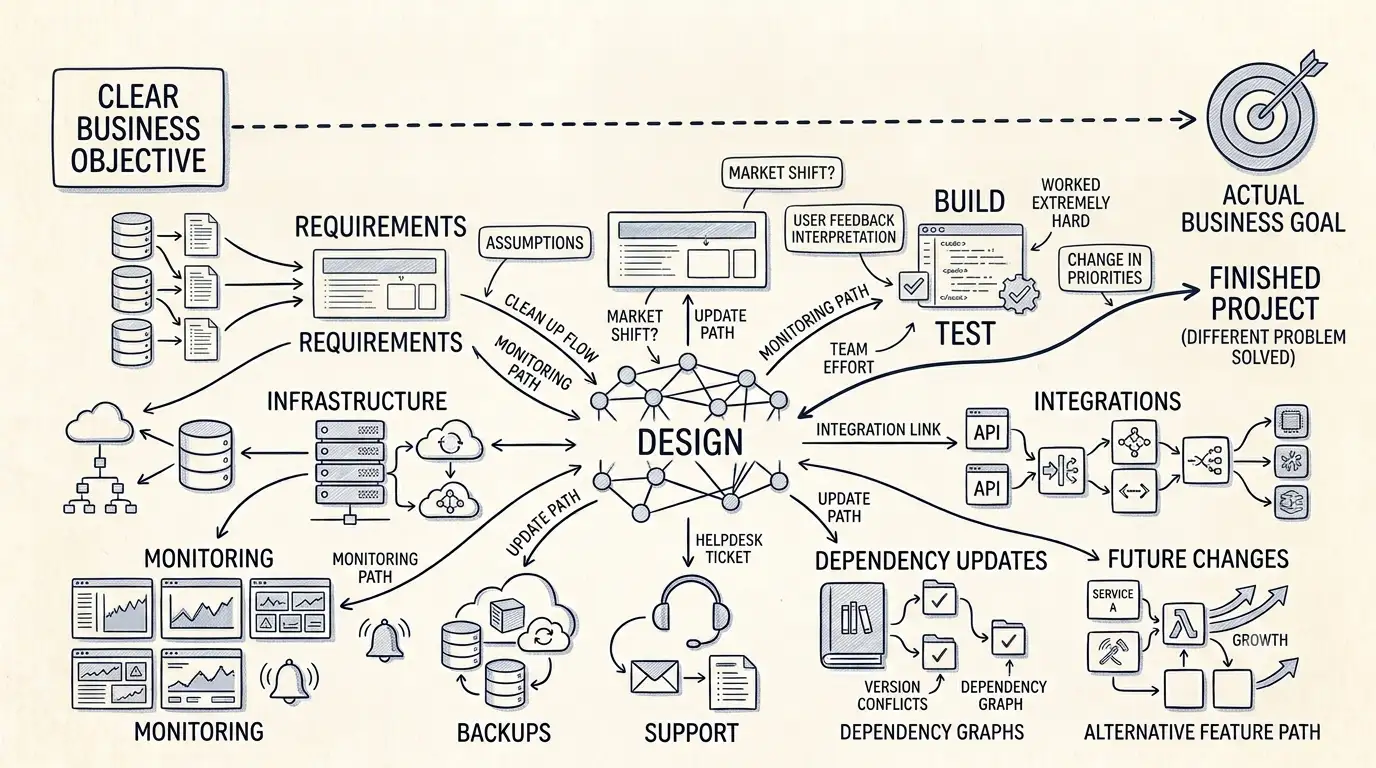

When a software project fails, the easiest explanation is usually:
“The developers weren't good enough.”
Sometimes that's true.
But many projects go wrong even when everyone involved is competent and working extremely hard.
The problem is often somewhere else.
Everyone Can Be Busy and Still Moving in the Wrong Direction
Imagine a team working for six months.
Developers are writing code.
Designers are producing screens.
Managers are running meetings.
The client is reviewing progress.
Tickets are being closed every week.
It looks productive.
Then the first real users try the system.
And something doesn't feel right.
The software technically matches the requirements.
But it doesn't solve the actual workflow.
That's not necessarily a coding problem.
It's a problem that started much earlier.
Requirements Aren't Always the Real Requirements
A business might say:
“We need a dashboard.”
But perhaps what they really need is a faster way for managers to identify exceptions.
“We need a mobile app.”
Maybe the real problem is that employees work away from their desks and need access to three specific actions.
“We need an integration.”
Perhaps the real requirement is simply that a particular piece of information should be available in another system.
If you build the requested feature without understanding the underlying problem, you can deliver exactly what was asked for and still fail.
Projects Also Go Wrong When Nobody Says No
Software projects naturally accumulate requests.
“Can we add this?”
“While you're doing that, can we also add...?”
“It's just a small change.”
Individually, each request sounds reasonable.
Together, they can completely change the project.
A good software team needs the confidence to say:
“That changes the scope.”
Or:
“This doesn't solve the problem you originally described.”
Or even:
“I don't think we should build this.”
That's not being difficult.
It's part of engineering.
Feedback That Comes Too Late Is Expensive
Another common problem is waiting until the end to show the finished product.
By then, assumptions have already become code.
The earlier you test an idea, the cheaper it is to change.
Show the workflow.
Test the difficult part.
Put something in front of actual users.
Find out where the assumption was wrong.
Then continue.
The Project Needs a Definition of Success
“Build the application” isn't a useful definition of success.
What should be different when the project is finished?
Maybe a process should take five minutes instead of thirty.
Maybe a report should be available without manual reconciliation.
Maybe customers should be able to complete something without calling support.
Maybe employees should no longer need a spreadsheet.
Those are outcomes.
They give the team something meaningful to work towards.
Hard Work Doesn't Compensate for Unclear Direction
Good people can spend enormous amounts of time solving the wrong problem.
That's why successful software projects need more than developers.
They need clear decisions, honest feedback, realistic scope and someone willing to keep asking:
Are we still solving the right problem?
If the answer stays yes, the project has a much better chance of succeeding.