




There is a strange category of software that causes more problems than it should.
It works.
The application opens. People can log in. Reports are generated. Data gets saved. Nothing is obviously broken.
And yet, everyone complains about it.
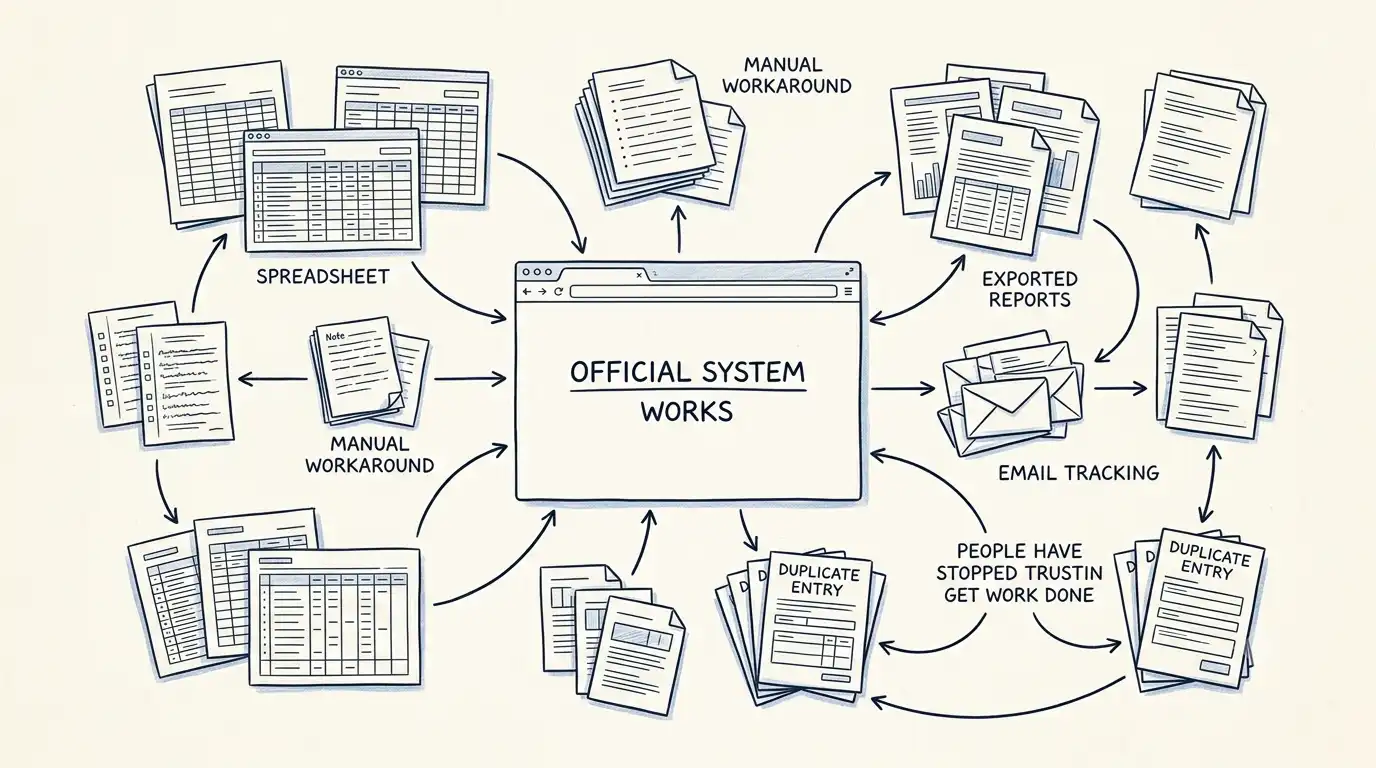
People keep spreadsheets beside it. They maintain their own notes. They send information over WhatsApp or email because the system is too slow or difficult. Someone has a personal process for getting around a limitation that nobody else knows about.
When something needs to be done, people often say:
“Don't use the system. Just do it this way.”
That is usually a sign that the problem isn't whether the software works.
The problem is that the software no longer works for the people using it.
Working Around Software Is Still a Software Problem
A business can become very good at working around bad software.
An employee exports data from one system, cleans it in Excel, and uploads it somewhere else.
Another employee keeps a separate spreadsheet because the application's report isn't useful.
Someone manually checks information in three different places before making a decision.
None of these things necessarily appear as software bugs.
But they all have a cost.
People spend time doing work the software was supposed to do. Information gets duplicated. Mistakes become more likely. Knowledge becomes dependent on particular employees.
Eventually, the workaround becomes part of the business process.
That's when things become difficult.
Why Does This Happen?
Software usually doesn't become frustrating overnight.
Businesses change.
A system built five years ago may have been perfectly appropriate at the time. Since then, the company may have added new products, new teams, new locations, new regulations or new customers.
The software didn't necessarily fail.
The business outgrew the assumptions it was built around.
There is another common reason: software gets changed without understanding how people actually use it.
A feature may technically satisfy a requirement while making someone's daily work harder.
For example, a management dashboard might show exactly the metrics requested during development. Six months later, managers may still export the data to Excel because they need to compare it differently.
Technically, the dashboard works.
Practically, it doesn't solve the problem.
Don't Start by Asking Whether the Software Is Old
Age is a poor way to decide whether software needs attention.
We've seen old systems that continue to do their job reliably.
We've also seen relatively new applications that people actively avoid using.
The better questions are:
What are people struggling to do?
What are they doing outside the system?
Where are they entering the same information twice?
Which parts of the system do people avoid?
What information do people not trust?
Which processes depend on one particular employee knowing the workaround?
Those answers tell you much more than the technology stack.
Sometimes the Answer Is Surprisingly Small
You don't always need a replacement system.
Sometimes one report needs to change.
Sometimes two systems need to exchange a small amount of information.
Sometimes a slow process can be simplified.
Sometimes a form needs to match the way employees actually work.
The mistake is assuming that a frustrating system automatically requires a major software project.
Before rebuilding anything, understand the actual problem.
The goal isn't to make software look newer.
The goal is to make the business less dependent on workarounds.
That's a much better definition of improvement.